
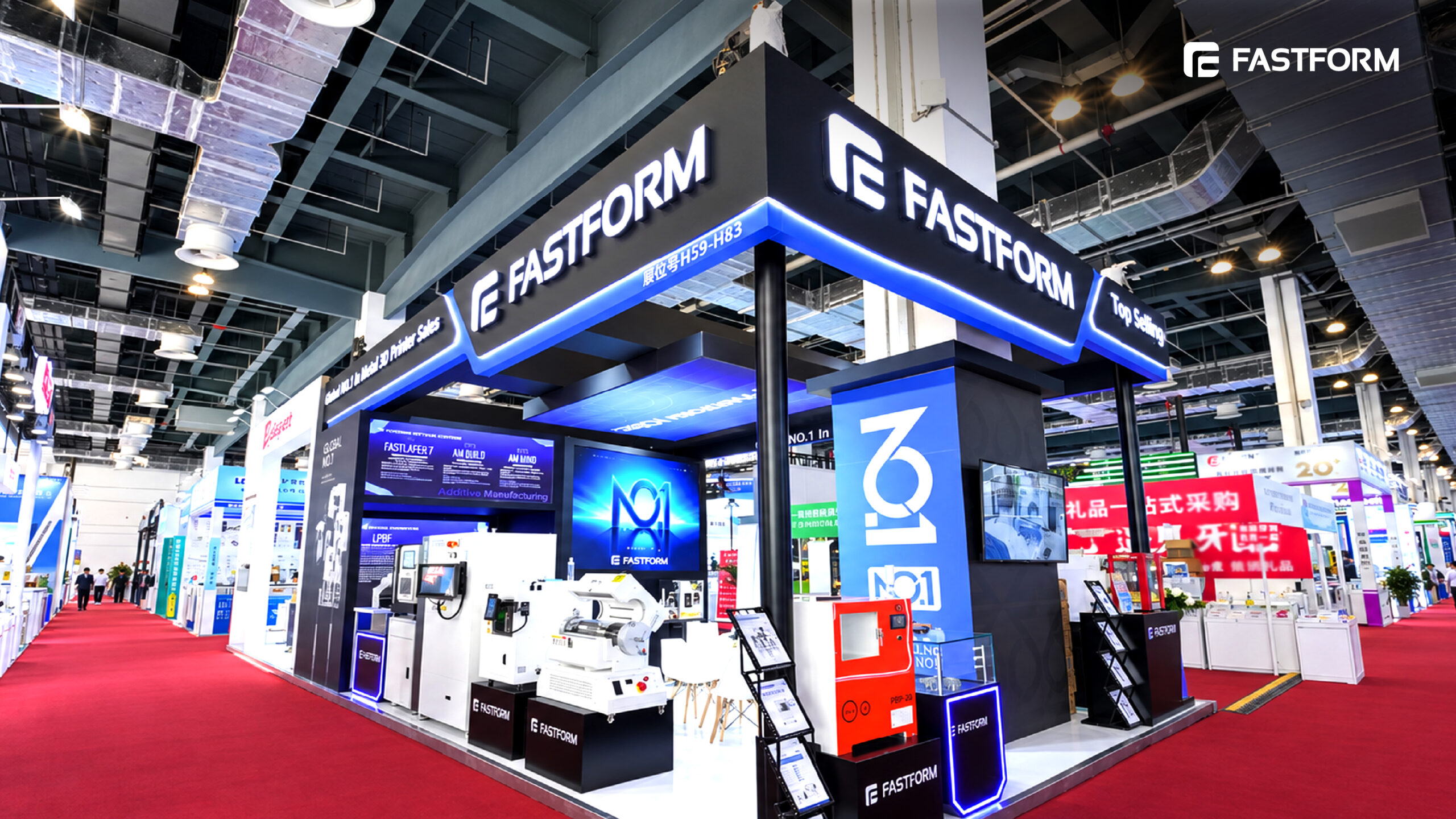
DenTech China 2026 opened in Shanghai on October 22, bringing together dental professionals, laboratories, equipment manufacturers, and technology providers from around the world.
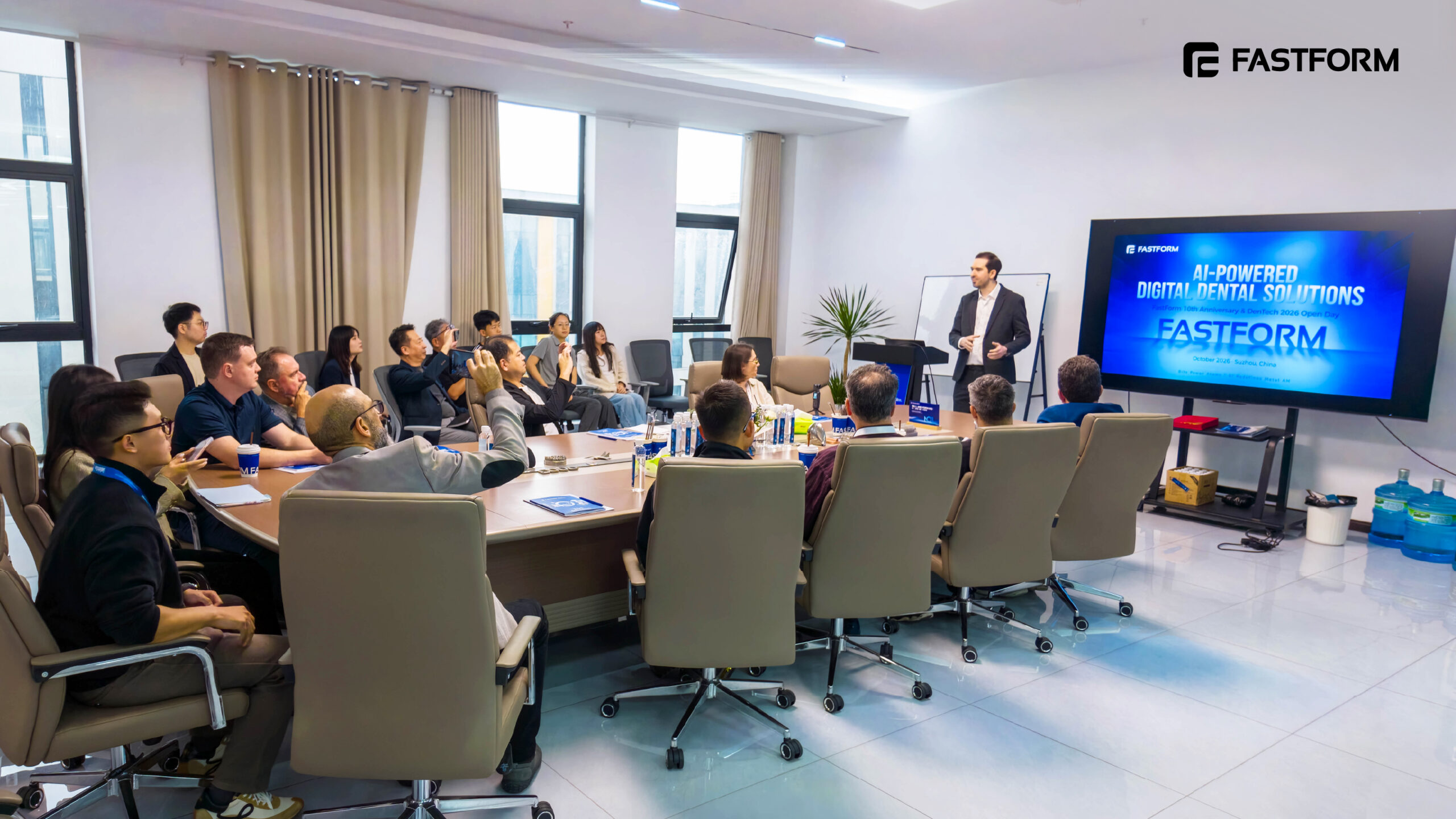
At the exhibition, FastForm presented FastLayer 7, its AI-powered build-preparation software for dental metal additive manufacturing. One of the key demonstrations showed the software completing the nesting and support preparation of 30 dental frameworks in approximately three minutes.
The demonstration attracted strong interest from dental laboratory professionals, particularly because it addressed a familiar production challenge: build preparation often depends heavily on experienced technicians.
AI Automation for Dental Build Preparation
In a conventional dental metal 3D printing workflow, technicians may spend one to two hours preparing a fully loaded build plate. Model orientation, connector-bar placement, nesting, and support generation all require time and practical experience.
The results may also vary between operators. During periods of high demand, preparation tasks can accumulate around a small group of experienced technicians, while printers remain idle waiting for build files.
FastLayer 7 automates four major preparation steps:
- AI-powered orientation analysis:
The software analyzes model features and determines a suitable build orientation. - Automatic connector-bar generation:
Connector bars are generated according to predefined process rules, with automatic interference avoidance. - Automatic full-plate nesting:
The software arranges dental frameworks across the build plate to improve space utilization. - Automatic support generation:
Supports are created according to model features and process requirements.
In the demonstrated FF-M220 production scenario, FastLayer 7 prepared a fully loaded build plate containing 30 dental frameworks in approximately three minutes. Compared with a manual preparation time of one to two hours, this represents an efficiency increase of up to 40 times under the stated test conditions.
The value of AI nesting, however, goes beyond speed. It transforms build preparation from an operator-dependent task into a more automated, standardized, and repeatable process.
After standard training, new operators can complete preparation tasks that previously required extensive hands-on experience. This allows experienced technicians to focus more of their time on process quality, exception handling, and other higher-value technical work.
Software and Hardware Developed as One System
Dental additive manufacturing users often rely on third-party software for build preparation. This can introduce additional licensing costs, paid upgrades, delayed technical support, and compatibility challenges between software and equipment.
FastForm follows a different development approach. Its software, process parameters, and metal 3D printing systems are developed as one connected platform.
FastLayer 7 links build preparation with FastForm’s process database and equipment software. This integrated approach helps reduce compatibility issues and allows software functions to reflect the actual operating logic and process requirements of the printers.
The platform provides several practical benefits:
- Lower long-term software costs:
FastForm provides ongoing software upgrades for eligible systems without the recurring upgrade model commonly associated with third-party solutions. - Faster technical support:
FastForm’s in-house software and application teams can respond directly to customer requirements. - Closer equipment integration:
Software and hardware are developed together, reducing the communication and adaptation gaps that can occur between independent suppliers.
FastLayer 7 is available across FastForm’s main dental metal 3D printing portfolio, including DeskFab X1, FF-M140, and FF-M220.
Solutions for Dental Operations of Different Sizes
FastForm has spent the past decade developing metal additive manufacturing solutions for dental applications.
Its portfolio covers different production requirements, from compact systems for clinics, education, and small laboratories to industrial systems for high-volume dental manufacturing.
This allows dental customers to select a solution that matches their current workload while retaining a path toward larger-scale digital production.
FastForm systems have now been deployed in Europe, North America, Asia-Pacific, Latin America, and other international markets. More than 3,000 systems have been installed worldwide across dental and industrial applications.
By connecting equipment, process knowledge, and AI-powered software, FastForm aims to help dental laboratories reduce preparation time, improve workflow consistency, and make better use of available printing capacity.
FastLayer 7 represents another step toward that goal: a dental production workflow in which automation supports operators, preparation becomes repeatable, and printers can move into production sooner.

*The three-minute preparation time and up-to-40-times efficiency comparison are based on a defined FF-M220 test scenario using 30 dental frameworks, standard test models, and a specified software version. Actual results may vary depending on the model, equipment configuration, process requirements, and software version.