
From FastLayer and AM Build to AM Mind, FastForm is bringing AI into preprocessing, process optimization, and autonomous operations across the metal additive manufacturing workflow.
Over the past decade, China’s SLM metal 3D printing industry has advanced rapidly. From four-laser systems to 26-laser platforms, from laboratory prototypes to large-format machines with build chambers reaching the two-meter scale, metal additive manufacturing hardware has made a remarkable leap toward industrialization.
But one fundamental question remains: As machines become larger and laser counts continue to rise, has the underlying production logic of metal 3D printing really changed?
Parameter development still depends heavily on experienced engineers. Support design often requires manual judgment. Complex geometries still involve costly trial and error. Equipment operation and maintenance continue to rely on skilled technical personnel. These challenges have remained largely unchanged even as hardware performance has continued to improve. At FastForm’s AI Large Model Technology Launch Event, company founder Li Shuai, who has worked in the metal additive manufacturing industry for 15 years, raised a direct question: “How much has SLM metal 3D printing fundamentally advanced over the past ten years?”
For FastForm, the answer points toward the next stage of the industry: Metal 3D printing is entering the AI era. As one of the earlier metal 3D printing manufacturers to develop its own slicing software, with more than 3,000 systems deployed, FastForm has accumulated not only equipment expertise but also extensive process data and real-world application experience. That foundation is now being used to bring artificial intelligence deeper into metal additive manufacturing.
From Hardware Competition to AI-Powered Metal 3D Printing
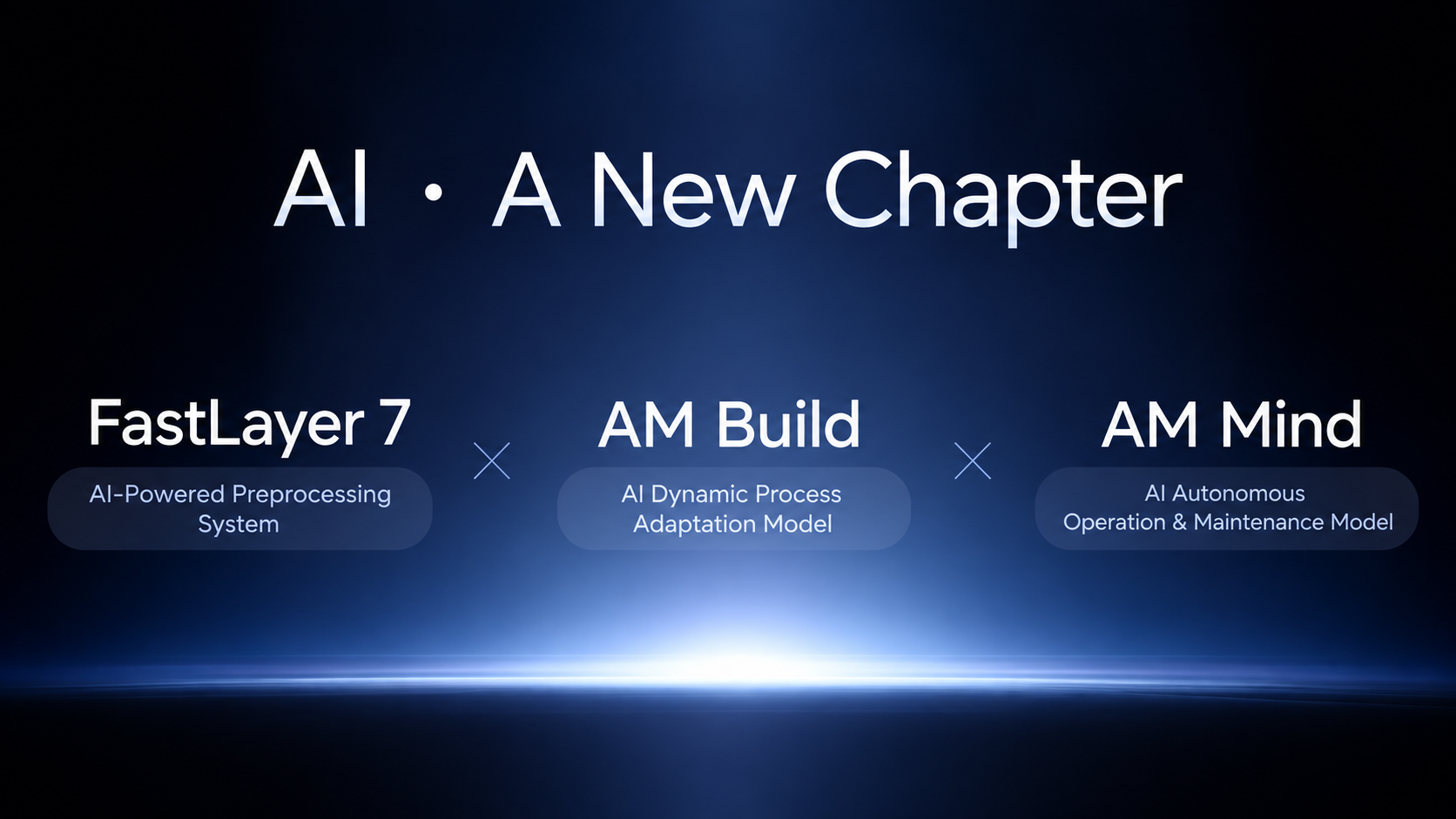
On June 26, 2026, FastForm officially introduced three AI technology systems designed to cover the core workflow of metal additive manufacturing:
FastLayer — Fully Automated Preprocessing System
AM Build — Dynamic Process-Adaptive AI Model
AM Mind — Autonomous Operations & Maintenance AI Model
Together, the three technologies extend AI across model preparation, process generation, printing, equipment operation, and production management.
FastForm describes its technical direction as: Software as the foundation. AI as the engine. Intelligent manufacturing across the entire workflow. Rather than adding isolated AI features to existing equipment, the company is attempting to reorganize the complete metal 3D printing workflow around software, process intelligence, and automation.
01. FastLayer: Automating Metal 3D Printing Preprocessing
Preprocessing has long been one of the most labor-intensive stages of metal 3D printing.
Model repair, nesting, support generation, slicing, and parameter selection all require technical knowledge and experience.
In batch-production applications such as dental manufacturing, footwear molds, and industrial tooling, preprocessing efficiency can directly determine whether a production line can operate efficiently at scale.
FastLayer is designed to move these tasks from engineer-driven operation to software-driven automation.
According to FastForm, FastLayer can smoothly process models at the 20 GB scale and automatically repair common mesh issues including self-intersections, non-manifold geometry, and mesh holes.
Automated Dental 3D Printing Workflow
For dental metal 3D printing, users can import crown or framework models and allow the software to automatically complete:
Nesting → Support Generation → Tie-Bar Generation → Data Preparation
This helps reduce manual preprocessing time and makes batch dental production easier to standardize.
Automated Processing for Footwear Molds
For footwear mold applications, FastLayer can automatically identify and segment patterned surfaces, select suitable assembly strategies, and match printing layer thickness to different geometric requirements.
This allows complex surface patterns to be processed more efficiently before printing.
Intelligent Mold Processing
For industrial mold applications, FastLayer supports automatic shell extraction and core generation.
Different layer thicknesses and laser spot strategies can then be assigned according to internal and external geometry, helping balance printing productivity with surface quality.
Multi-Machine Production Management
FastLayer also supports intelligent multi-machine nesting and cloud-based data management.
By connecting production orders, printer clusters, process parameters, production monitoring, and manufacturing data, the software helps metal additive manufacturing move beyond standalone machines toward coordinated multi-machine production.
02. AM Build: Turning AI Into a Metal 3D Printing Process Engineer
If FastLayer focuses on efficiency before printing begins, AM Build addresses one of the most fundamental challenges in metal additive manufacturing: process control.
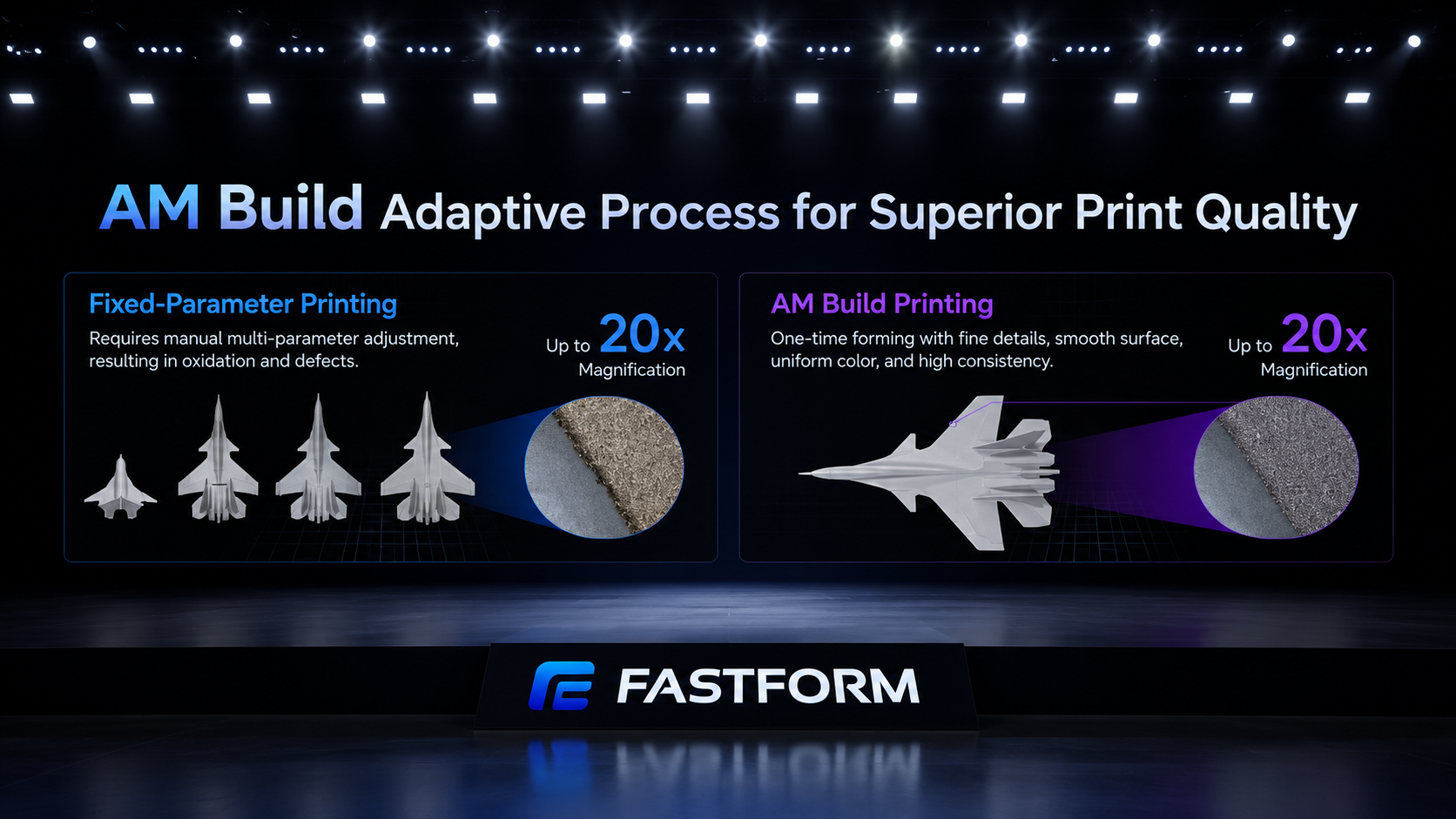
Traditional SLM production commonly relies on a predefined set of parameters throughout a build.
Yet different materials, geometries, overhang angles, thermal conditions, and stress distributions can require different processing strategies. Engineers therefore often need repeated testing and parameter adjustment. That process consumes time, powder, machine capacity, and engineering resources.
AM Build takes a different approach. The dynamic process-adaptive AI model can optimize printing strategies according to part geometry and printing conditions, adjusting the process for different layers and regions of a component. Instead of relying entirely on fixed parameters, AI becomes part of the process decision-making workflow. FastForm demonstrated several applications of AM Build at the launch event.
Support-Free Metal 3D Printing
In one demonstration, an inverted aircraft model was printed without conventional support structures.
Reducing unnecessary supports can help lower material consumption while also reducing support-removal and post-processing work.
25 mm Unsupported 0° Horizontal Bridge
AM Build also demonstrated support-free printing of a 0° horizontal structure with a span of up to 25 mm.
Horizontal overhangs are traditionally among the more challenging geometries in metal powder bed fusion.
Adaptive process control offers a new approach to expanding design freedom while reducing support requirements.
Distortion Control for Thin-Wall Components
Thin-wall shells are particularly sensitive to thermal stress and deformation during metal 3D printing.
AM Build dynamically adjusts printing strategies according to part geometry and build conditions, helping reduce distortion risks without relying entirely on repeated manual parameter tuning.
Improved Overhang Surface Quality
In a 35° overhang printing test, FastForm reported a surface roughness of Sa 23.60 μm compared with Sa 47.52 μm for the referenced 45° baseline process.
The result demonstrates the potential of adaptive process control to improve difficult overhang surfaces while expanding printable geometry.
For production users, the value of these technologies is straightforward:
Less Support · Lower Powder Consumption · Less Post-Processing · Less Manual Intervention · Greater Process Consistency
Rather than simply making machines faster, AM Build is intended to make the printing process itself more intelligent.
03. AM Mind: Turning Engineering Experience Into an AI Model
The third technology announced by FastForm is AM Mind, an AI model designed for autonomous equipment operation, maintenance, and production optimization.
In a metal 3D printing factory, final part quality can be influenced by a wide range of variables:
equipment condition, alarm information, process parameters, material batches, environmental conditions, and machine operating history.
Traditionally, identifying and resolving these issues depends heavily on experienced service and process engineers.
AM Mind is designed to convert that accumulated engineering knowledge into a specialized AI system.
Unlike a general-purpose large language model, FastForm says AM Mind is built specifically for metal additive manufacturing equipment and process environments.
Its architecture combines physical rules with real industrial data, with an emphasis on explainability, reliability, and low false-diagnosis rates.
Built on Real Metal Additive Manufacturing Data
According to FastForm, the AM Mind knowledge base incorporates:
60 million lines of industrial operating data
10,000+ hours of real-machine testing
Operating data from 3,000 metal 3D printers
More than 100,000 pages of technical documentation
Process and service experience from senior engineers
The system can extract printing parameters, analyze software and hardware files, organize process algorithms, evaluate equipment status, and generate production optimization recommendations.
This represents a major shift in how AI could be used in metal additive manufacturing.
Instead of simply helping engineers search technical documents, AI may increasingly participate in equipment diagnostics, process analysis, and production decision support.
Building an AI Closed Loop for Metal Additive Manufacturing
Taken together, FastForm’s three AI systems address three critical stages of industrial metal 3D printing.
FastLayer improves preprocessing automation.
AM Build introduces adaptive process intelligence during printing.
AM Mind extends AI into equipment operation, diagnostics, and production management.
Together, they create an AI-driven workflow extending from:
Model Preparation → Process Generation → Printing → Equipment Operation → Production Optimization
This is where the significance of FastForm’s AI strategy becomes clearer.
For years, competition in metal additive manufacturing has focused heavily on hardware specifications:
How large is the build volume?
How many lasers does the machine have?
How fast can it print?
Those questions still matter.
But as metal 3D printing moves deeper into serial production, customers are increasingly focused on different metrics:
Can production require fewer skilled operators?
Can trial and error be reduced?
Can parts be printed successfully the first time?
Can manufacturing remain stable across multiple machines?
Can overall production costs continue to decrease?
The answers may no longer come from hardware alone.
They increasingly depend on the integration of software, process intelligence, automation, and AI.
The Next Competition in Metal 3D Printing Is AI
Metal additive manufacturing has spent the past decade expanding the physical capabilities of the machine.
Larger build volumes, more lasers, faster scanning, and greater productivity have pushed the technology steadily toward industrial manufacturing.
The next stage may be different.
Instead of simply adding more hardware, manufacturers are beginning to make the entire production system more intelligent.
FastForm’s approach reflects this transition.
By combining automated preprocessing through FastLayer, adaptive printing intelligence through AM Build, and autonomous operations through AM Mind, the company is building toward a metal 3D printing workflow that requires less manual intervention and can be more easily standardized and scaled.
FastForm may not be the industry’s largest player, but it continues to challenge conventional approaches to metal additive manufacturing and explore how AI can fundamentally change the production workflow.
And there is another example of that willingness to experiment:
FastForm has also introduced what it describes as the world’s first “Lobster” AI metal 3D printer, bringing AI interaction directly into the machine experience.
The hardware race is far from over.
But the next major competition in metal 3D printing may already have begun: the race for AI-powered manufacturing.